
Digital product catalog for industry and manufacturers
ECOPLAN implements digital product catalogs for complex product ranges and technical products, integrated with ERP, PIM, and other enterprise systems.




















Make complex product ranges easy to find
Especially with technical products and large product ranges, structure determines whether customers and employees quickly find the right product. Categories, attributes, filters, search functions, and product relationships make even complex product worlds clear and easy to navigate.
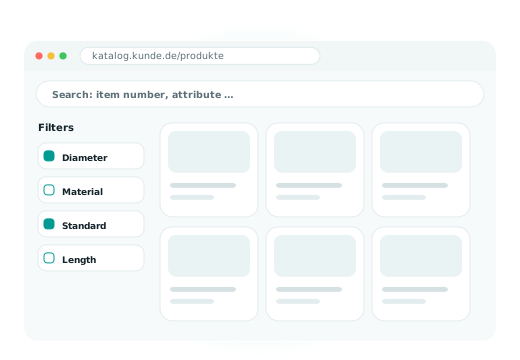
The largest product catalog ECOPLAN has implemented comprises around 250,000 product variants, displayed on 30 different websites in 12 different languages.
250,000
Product variants in one catalog
30
Websites with display
12
different languages
Use product data from your systems
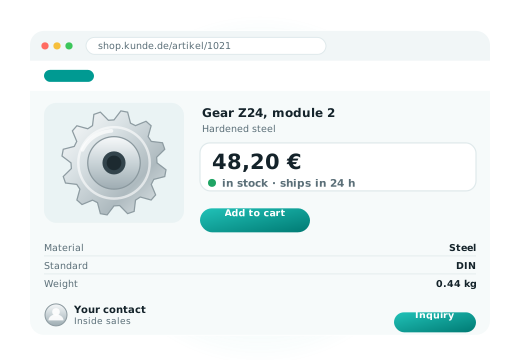
Technical attributes, variants, images, and data sheets usually come from the PIM; article numbers, units, and availabilities from the ERP. ECOPLAN brings both together so that each piece of information is maintained in only one place.
ERP, e.g.:
SAP







Other systems:
Catalog systems
Document management
Media/asset systems
How a digital product catalog relieves sales and service
In many companies, product information is still regularly provided manually or pieced together from different systems. A digital product catalog provides this information centrally and in a structured way.
Customers, sales, and service can find and use products, technical data, documents, and accessories on their own. This reduces the effort for recurring information requests, manual provision of documents, and duplicate maintenance.
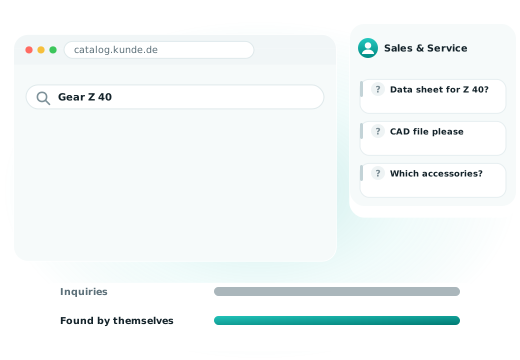
Fewer follow-up questions
Less manual provision
Faster product search
Central use of existing product data
Services for implementing your product catalog
ECOPLAN supports companies from the analysis of existing product data and data sources, through structuring and conceptual design, to the technical implementation and integration of the digital product catalog.
In the process, information from ERP, PIM, catalog, and other enterprise systems is brought together and prepared so that it becomes useful for customers, sales, and service.
01
Analysis & consulting
02
Data structure
03
Conceptual design
04
Integration
05
Implementation
06
Further development
For technical products that require explanation
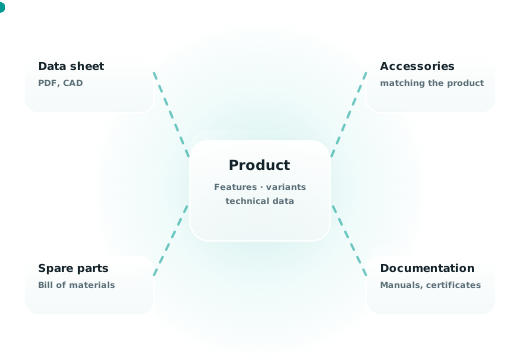
Digital product catalogs make the most sense where product ranges are extensive, technical, or rich in variants. ECOPLAN has project experience in industries where product attributes, documentation, accessories, spare parts, and complex product relationships play an important role.
From product catalog to B2B web shop
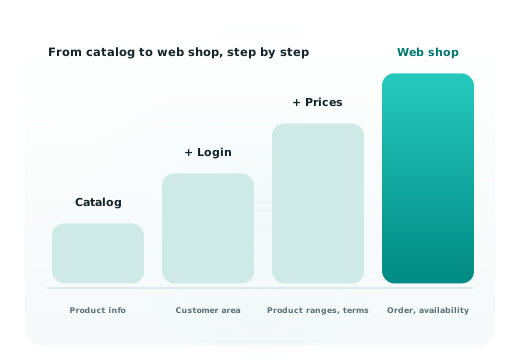
A digital product catalog can start on its own and be expanded step by step later. Customer login, customer-specific product ranges and prices, availabilities, or ordering functions can be added when product information is to become a digital sales channel.
This way, ECOPLAN develops a product catalog into an integrated B2B web shop when needed, without rebuilding the existing product data foundation.
One product catalog for multiple countries, companies, and brands
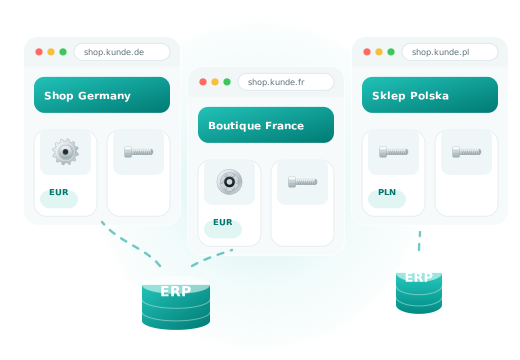
ECOPLAN implements product catalogs for multiple countries, sales organizations, and brands. Product data is maintained centrally and delivered per market with its own languages, product ranges, and content.
ECOPLAN product catalogs in practice

Gühring - tools
Around 250,000 products and variants on 30 websites for more than 20 countries.

Profine - construction
Around 80,000 products for 10 countries, connected to SAP.
We work with award-winning solutions
avanta awarded as Leader in the category "B2B E-Commerce Platforms & Shop Systems" on OMR Reviews.


Are you planning a digital product catalog?
Whether a new online product catalog, replacing an existing solution, or stronger integration with ERP and other enterprise systems: ECOPLAN supports you from concept through implementation and further development.
Simply fill out the form. We will get back to you within 2 business days.
If you would rather talk directly, book an appointment with us. You will receive an initial expert assessment, in 30 minutes by video conference.